As winter rolls in and the season of office parties fades into the season of empty offices, it is time to pause and take stock. It is hard to imagine that we will be looking back on 2009 as the good old days any time soon, but things could certainly have been worse.
 The end of 2009 also marks, more or less, the end of the first year of this blog. So it makes sense to review the year by reviewing the year in the blog. In the next few posts I will be highlighting a few general themes that emerged as the year went on. Today it is the most obvious of topics, The Great Recession.
What set off the GR was best discussed here at Bad Money Advice in a book review I wrote (in two parts) of the probably now forgotten The Wall Street Journal Guide to the End of Wall Street as We Know It. I meant to do more book reviews when I started this blog.
Read more »
Earlier this week I stumbled across a surprisingly on-target quote about what got us into this economic mess from, of all people, Treasury Secretary Timothy Geithner.
The failures that led to this financial crisis were many. Banks and investors took on large risks, risks they did not understand. Washington allowed those risks to build up unchecked. And in communities across the country, Americans borrowed too much in part because they did not understand how to save prudently, how to borrow responsibly, and they did not understand fully that pension values and house prices, equity prices will not always rise.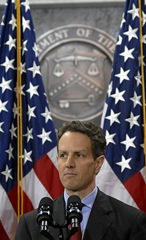
It’s not a perfect explanation. I wouldn’t make the general statement that banks and investors didn’t understand the risks they were taking. Some didn’t, but many understood quite well. And I think Washington was more than a passive observer of the whole mess.
But the blame laid at the feet of Wall Street and the government is mostly pro forma here. What Geithner is saying is that, as it turns out, a widespread lack of financial acumen amongst ordinary folks was at least as damaging as the foolishness amongst the bankers and bureaucrats. In the immortal words of Pogo "We have met the enemy and he is us."
Read more »
In yet another sign that the Great Recession is receding, earnest discussion has begun in the punditocracy on long-term cures for our nation’s home mortgage system, particularly Fannie Mae and Freddie Mac. (Remember them?)
 I’m not sure if anything at all will come of this. It’s not clear that Congress has enough gas left in the tank to finish with healthcare, never mind rewiring the mortgage business. If I had to bet money I would say that this window of opportunity, in which there is consensus that something needs fixing, will close without much of anything changing.
But it’s inspired some rare discussion of that great American institution, the thirty year fixed rate mortgage. And it really is a uniquely American institution. Except for Denmark, which has a very peculiar system dating to the Eighteenth Century, only in America do consumers think that borrowing on thirty year fixed rates is normal.
Read more »
Trawling The Consumerist for something to write about I was excited to find a post entitled An Argument For 401(k) Minimizing. It turned out to be about a post at Punch Debt in the Face that, at most, argues against 401(k) maximizing. Still, that’s something.
I like Punch Debt in the Face. Although I am clearly at least a generation too old to fully relate, and the layout still reminds me of a ransom note, the Twitter graphic alone is worth the click. And the blog’s author, Debt Ninja, is endearingly hostile to conventional wisdom and insists on doing his own math. My kinda guy.
Debt Ninja’s post contains what ought to be a mundane discussion of reducing his 401(k) contribution from 8% to 5%. He also contributes to a Roth IRA and makes the argument that being a very rich 60 year-old in exchange for being an impoverished 25 to 59 year-old is not a good deal.
Read more »
Saturday night before last, Suze Orman issued yet another directive to her followers about credit cards. Readers may recall that back in March Suze told  us that we should make only the minimum payments on our cards until we had an emergency fund equal to eight months’ expenses built up. That inspired one of my many unsuccessful business ideas.
Well, March was a long time ago. Stock and house prices are up, the recession has ended, and it even looks like the unemployment rate has crested. So I guess it is time for Suze to change strategies once again. This time the idea is to drop the cards. "Let’s go back to the times when you literally paid cash for everything. That’s right. Cash. Stop using your credit cards altogether.”
I don’t watch Orman’s show. I found out about this from a post at SmartSpending, as well as a post at Get Rich Slowly. That post, written by our friend Baker from ManvsDebt, has the virtue of an embedded video of Orman challenging us to spend only in cash. You can even sign up to join her Back to Cash Movement.
Read more »
 The end of 2009 also marks, more or less, the end of the first year of this blog. So it makes sense to review the year by reviewing the year in the blog. In the next few posts I will be highlighting a few general themes that emerged as the year went on. Today it is the most obvious of topics, The Great Recession.
 Economics, Government, Housing, Media, The Big Picture | Frank Curmudgeon |
  December 21, 2009 2:37 pm |
  Comments (101)


 Subscribe