I have managed to go since August 20th without mentioning Brett Arends of the Wall Street Journal. It hasn’t been easy, but for 59 posts I have stayed on the wagon. Until now. Arends’ Wednesday column was just too strong a temptation. It had the siren-call title of "Are Your U.S. Treasury Bonds Safe?" How am I supposed to ignore that? I  am only human.
Needless to say, the column lacked a yes/no answer to its headline. Sure, "Standard financial theory defines "the risk-free rate of return" on money as the rate of return you can earn on Treasurys" but this time is different: the government is now in the control of politicians who like to spend money and don’t like to raise taxes.
But as the U.S. government piles borrowing atop more borrowing, it begs a financial question that is not utterly ridiculous: Are your U.S. Treasury bonds safe?
Read more »
Investing was actually my second career. For the six years between college and B-school I wrote software. Back then, we Dilberts had a phrase we used to parody the marketing types who sold what we made. "It’s not a bug, it’s a 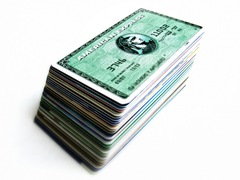 feature!" In other words, that obvious flaw in the software is not, in fact, a mistake that makes it less useful, it is a brilliant design decision that actually makes it better and worth more to you, the customer.
I also, at this time, had an American Express card, paying, I think, $50 or $75 a year for the privilege. I honestly forget why. I think I got it while still in college under some kind of special deal. And there was this store I frequented that in those days only took Amex. Anyway, by the time I was 25 I came to my senses and cancelled the thing. They sent me a nice letter saying that if I ever came back I could still have a card that said "Member Since 1986".
So I’ve got that going for me.
I was reminded of both these things from my past by a brilliant new marketing campaign from American Express. For those of you not familiar with such things, let me explain that the conventional Amex card is not a credit card but a charge card. That is, they do not provide credit for longer than it takes them to send you a bill. You are expected to pay the full balance every month.
Read more »
Last week The Consumerist had a post telling readers to Go Ahead, Strategically Default On Your Underwater Mortgage. This was based, more or less, on a paper from a law professor at the University of Arizona which addressed the legitimate conundrum of why strategic defaults are not more common.
A strategic default on a mortgage is when a borrower can make the payments  but chooses not to. In other words, the borrower hands the keys over to the lender and walks away. It is important to remember that, despite much play in the media and academia, this is still a rather exotic maneuver. In order for a borrower to even begin considering such a move two things need to be true.
First, obviously, the house has to be worth a lot less than the outstanding mortgage balance. Or, in current slang, it needs to be substantially underwater. Swapping ownership of the house for extinguishing the debt is, essentially, selling the house for what is owed, and if what is owed is not meaningfully higher than what the house is worth, this would be a bad deal.
Read more »
The other week WalletPop had a post Want happiness? Forget money – get therapy instead in which was explained that money can’t buy happiness, unless you spend it on psychotherapy.
 This was based on a study (discussed a little more completely here but not, as far as I can tell, available on the web) done by two British professors. They found that £800 worth of therapy was the happiness equivalent of a pay rise of £25,000.
Alas, this was not experimental science. As much fun as it would have been, the researchers did not choose people at random and give them piles of cash or toss them onto the couch. All they did was find that people who themselves decided to get therapy experienced the same increase in self-reported happiness as those that got a big raise.
Read more »
November brought a wealth of new frugal tips, many of them seasonally themed.
Wise Bread kicked the month off right by reminding us, as if we needed it, that early November is the right time to buy Halloween costumes and decorations. But beware of those topical items that may not work next year, e.g. the white sequin glove coming out of a grave.
Wise Bread also shared a timeless list of 20 Money-Saving Ways to Reuse Old Pantyhose. Sure, some of them are pretty obvious, like using them to store onions and potatoes, but several are of the forehead slapping why-didn’t-I-think-of-that variety. Used nylons can be used to make homemade soap-on-a-rope, as plant ties, and even as storage for those "menacing foam packing peanuts."
Read more »
 am only human.
  Government, Investing, Media | Frank Curmudgeon |
  December 11, 2009 12:59 pm |
  Comments (444)


 Subscribe