There now seems to be a consensus that the collapse of Lehman Brothers last fall was the watershed moment of the Great Recession. What exactly happened and why will be a hot button topic in some circles for many years to come. Books and websites will argue the the government should/shouldn’t/couldn’t have saved it. In a decade or so some professor of economic history will probably write a book about how it wasn’t that important an event after all. And inevitably some cranks will come up with a conspiracy theory linking the whole thing to the Chinese government or orbital mind control lasers.
That’s all in the future. In the here and now the big arguments about the Lehman failure are over the pathetically small morsels of flesh still left on the carcass. In as much as Lehman still exists, it exists as a small band of people with the grim task of liquidating what is left, trying to get the payout to Lehman’s remaining creditors increased to, say, two cents on the dollar from one cent.
Lehman expired owing $200 billion it couldn’t pay. Its brokerage business and real estate (a.k.a. the only big obvious bits worth anything) were sold in a hurry to Barclays a few days after the bankruptcy. Barclays paid $1.54 billion, which may sound like a big check to write under the circumstances, but amongst the assets they got $4 billion in securities and cash. It was thought at the time that along with the assets went matching liabilities, including equipment leases, money owed employees, etc.
Read more »
On Monday the New York Times ran a piece that, in a better world, would not have been news. Turns out that credit card companies are often willing to settle delinquent accounts for less than what is owed. Golly.
The article did contain an important tip for those in serious credit card trouble. When the card issuer calls you out of the blue and offers to let you 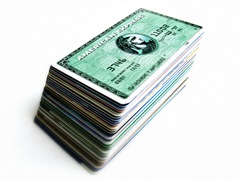 settle the whole thing for 80 cents on the dollar, you should, without hesitation or reflection, say no. Then hang up. They’re not calling because they think you’ll pay them eventually. That 80% is what we Wall Street types call a “first offer”.
The Times piece tells the story of a guy who got a call like this, said no thanks, and then when the company called back a few weeks later, offered them 50%.
It’s a deal, the account representative immediately said, not even bothering to check with a supervisor.
Where I come from, the account rep would be considered very rude. Proper etiquette would have been to put the customer on hold for thirty seconds while pretending to beg a supervisor to okay the deal. At the very least, the rep could have heaved a big sigh and mentioned something about how will probably be fired for this.
Read more »
Our elected leaders are currently working up a head of steam to reform healthcare. Good luck with that. The mere fact that they vaguely call the effort "reform" tells you it’s going to be a very steep hill to climb. What nobody wants to say out loud is that the big problem with healthcare is that we spend so much on it, and we can’t spend meaningfully less on it without getting less of it. Like I said, good luck.
In the US, we spend about 12.5% of GDP on healthcare, a higher percentage than any other developed country. However, I think we can all agree we get  rather a lot for our money. In contrast, we spend 2.6% of GDP on higher education, also the highest developed world percentage. And of course, we get something for our money here too. I for one am glad our doctors went to medical school. But dollar for dollar I think we’re getting a lot more value from healthcare.
Why do we spend so much on higher education? And why isn’t it considered a crisis worthy of reform? Part of the problem is a cultural attitude that higher education is a kind of higher calling. Attending college is a good thing in an abstract and noble way that doesn’t lend itself to cost benefit analysis. Asking if it is a wise investment in dollar terms just seems tawdry.
Read more »
Last week the New York Times ran an installment of its Wealth Matters column entitled How Do I Know You’re Not Bernie Madoff? Literally, it’s an easy question to answer. (Because I’m not in prison.) But figuratively it’s an important question for which everybody with money to invest should have an answer.
The column starts out with a brief interview with a private wealth manager with the impossibly appropriate name of Tony Guernsey. (A posh off-shore banking center?) And there’s a picture of the fellow. He looks exactly as Ralph Lauren would have him look: tortoise shell glasses, chalk stripe suit, and chin thoughtfully rested in right hand. In the foreground there is (I swear I’m not making this up) a small red flag.
Tony Guernsey has been in the wealth management business for four decades. But clients have started asking him a question that at first caught him off guard: How do I know I own what you tell me I own?
Read more »
One of several recurring sub-themes here at Bad Money Advice is that some givers of personal finance advice, particularly the mass market gurus, say things that can only be justified assuming an irrational audience incapable of acting in their own best interest.
 So, for example, when Suze Orman tells her readers that they should absolutely never borrow from their 401k account to pay off a credit card balance, I give her a hard time for giving terrible advice based on the assumption that her audience has no willpower and will merely run up the credit card balance again.
But when I criticize the gurus for giving bad money advice that is, in fact, bad psychotherapy, I do not mean that everybody ought to be able to behave in a perfectly rational manner around money. Quite the opposite. We are all merely human, not uber-logical Vulcans. We act sub-optimally around money (and everything else) for a variety of emotional and behavioral reasons.
Read more »
 theory linking the whole thing to the Chinese government or orbital mind control lasers.
 Musings | Frank Curmudgeon |
  June 19, 2009 2:54 pm |
  Comments (787)


 Subscribe