In his Wall Street Journal column from Saturday, Jason Zweig asks Does Stock-Market Data Really Go Back 200 Years? My head immediately fills with responses.
Of course not.
Why would you think it did?
Who could possibly care?
The title of the column isn’t a trick or a pun. It is really a serious examination of the quality of the stock market data prior to 1845. That was a period when the the “stock” in New York Stock Exchange mostly meant what we today call Treasury bonds. Corporations were rare, each was specifically chartered by a state legislature, and they were widely considered to be a sinister product of financial engineering gone amuck.
Read more »
This week the carnival is hosted by our friend Baker at Man Vs Debt. It’s the New Zealand edition because "my family and I are currently backpacking and job-hunting in New Zealand." I’m suspicious. Sure, we’ve all combined backpacking and job hunting at some point in our lives, but New Zealand? Reminds me of a certain southern governor.
Baker did have the good taste to select my post about the guessing of Social Security Numbers as an editor’s pick. I’m sure you’ve all read it by now, but you might have missed the  lengthy comment left over the weekend by the authors of the academic paper that started the whole thing.
Another editor’s pick was from Good Financial Cents on the income caps on Roth IRA contributions effectively going away in 2010. It’s a topic I’ve discussed on this blog and one that will undoubtedly get more play as 2010 approaches. My personal opinion is that the government will close this particular unintended loophole sooner or later, but it’s worth understanding in the meantime. Also, the post makes reference to the Violent Femmes, which is a plus.
Read more »
I’ve been hoping for a Brett Arends column I could say something nice about, and last week I got my wish in the form of Baby Boomers to Kids: Kiss Your Inheritance Goodbye. The theme of the article, or the first few paragraphs  anyway, is the trend of dropping a nice inheritance for the kiddies from the retirement plan in reaction to the market swoon.
I myself am just a bit too young to be a Baby Boomer and my parents just a little too old, so I am merely an outside observer on this one. But I have to ask those kids of Boomers out there: you were expecting to inherit something? From the Me Generation? Really?
A few paragraphs into Arends’ column he abruptly starts talking about annuities. This may seem like a non sequitur, but it follows nicely from the idea that retirees may be jettisoning the legacy for the children from their planning.
Read more »
That can’t be right.
In response to my call for examples of dubious published numbers that might obey Curmudgeon’s Law of Numerical Fiction, frequent commenter GPR suggested a real gem. The artists Christo and his wife Jeanne- Claude want to construct one of their larger works of art over a river in Colorado. This will, we are told, add just shy of $200 million to the local economy.
Although it will take two years to build Over The River, and several months to take it down, the artwork will exist in all its glory for only two weeks. During this time, OTR will attract, the artists claim, 380,000 visitors, 62% of them from out of state. Another 180,000 will show up to see it being built and torn down. This will generate $195.5 million in economic activity, $78.3 million of which will be spent in the Denver metro area.
Denver is about two hours from the base of the site, assuming normal traffic, which seems unlikely.
Read more »
The latest hot topic on the identity theft front is a paper published on Monday in The Proceedings of the National Academy of Science by two professors at Carnegie Mellon on how easy it is to guess a person’s social security number.
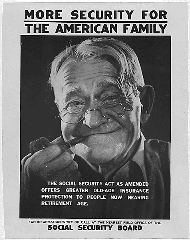 That day Ars Technica reported on it. Also, the authors of the paper started a blog on it. The AP picked it up Tuesday. CrunchGear blogged on it then too. And Wednesday brought posts from Wise Bread and Wallet Pop.
This is a great story. It combines several of my favorite themes. There’s the ever amusing hysteria over identity theft, which apparently renders a person incapable of rational thought and perspective. There are the unintended consequences of seemed-like-a-good-idea-at-the-time government policies. And there is the recurring phenomenon of folks who report and comment on academic papers without reading and/or understanding them.
Read more »

 Investing, Media | Frank Curmudgeon |
  July 15, 2009 10:30 am |
  Comments (76)


 Subscribe